

Calling Teenagers Upward
A reflection on the strange work of writing a sermon for teenagers

| Bookstore | Contact | Shop |
B.D. Fleming: | Facebook | X | Instagram | Threads |
The Old Forge Press: | Facebook | X | Instagram | Threads |
Writing a sermon is still strange to me.
I have only been doing it for eight or nine months, so I still feel the weight of it every time I sit down to write. There is a heaviness to knowing that you will stand before people with eternal souls, open the Word of God, and say “Thus says the Lord.”
That is never casual work, and there’s a level of anxiety that comes from it. Not to mention the anxiety of public speaking in general.
But, I’m finding that writing a sermon for teenagers, feels even stranger.
Teenagers aren’t impossible to understand or something like that. I vividly remember being a teen, and one of the things I hated was when an adult would try to be gimmicky when they spoke to us. Or try and be “cool,” because they seemed to think that we were incapable of serious thought. I think we insult them by assuming that. They are image-bearers. They are moral creatures. They are sinners. They are being discipled every day by something. And many of them are far more capable of receiving weighty truth than we give them credit for.
But that is part of what makes it difficult for me.
I don’t want to preach down to them. I don’t want to act like the only way to reach them is to turn my hat around backwards, try and sound like them, joke like them, or flatten the message until it feels like a devotional thought with a Bible verse attached.
At the same time, I do not want to overshoot them. I do not want to preach a sermon that sails clean over their heads. Faithfulness in preaching, after all, is not measured by how complicated I can make the message. The goal is not to impress adults listening in the back of the room. The goal is to bring the Word of God to bear on the hearts of young men and women who desperately need Christ.
So, the task is not to preach at their level in some patronizing sense. The task is to meet them where they are, and call them upward. I’m finding that’s harder than it sounds.
Especially because, in much of modern church culture, we have trained our children to think of the gathered church as something they participate in only at the margins. They may sing with us. They may stand beside us. But then, often, they are separated from the main life of the church. They are shuffled into age-specific environments where everything is adapted to them, curated for them, softened for them, shortened for them, and made constantly engaging for them.
Then, at some point, we wonder why they struggle to sit under preaching. We wonder why they seem unused to spiritual weight. We wonder why they have little appetite for doctrine, little stamina for worship, and little expectation that the Word of God should confront them, command them, comfort them, and change them.
But we should not be surprised when children who have rarely been expected to sit under the ordinary means of grace find the ordinary means of grace difficult.
Attention span is not merely a biological issue. It is a formation issue, and I see it written on their faces when I stand behind the pulpit. They’re not malicious or even intentionally not paying attention. They’re bored!
Many teenagers can scroll for hours, but struggles to listen for fifteen minutes. That’s proof that culture catechizes, and that attention can be trained. (By the way…this isn’t just a problem for teens. I wonder if even a few adults who start this article won’t even finish because of short attention spans or constant distractions).
That means preaching to teens is not simply about communication. It is about re-formation.
It is about saying, “You are not a demographic to be entertained. You are not a market segment to be captured. You are not a problem to be managed until adulthood. You are young men and women standing before the living God.”
And for me, that has changed the assignment.
It means I have to be simple, clear, and direct without being harsh, shallow, or cute.
It means I have to remember that some of them are not used to being called upward. They are used to being accommodated. They are used to being excused. They are used to being spoken to as if they are fragile consumers rather than future fathers, mothers, husbands, wives, church members, leaders, workers, builders, and soldiers in the Kingdom of Christ.
But the Bible does not speak to young people as if they are incapable of obedience.
“Remember also your Creator in the days of your youth.” (Ecclesiastes 12:1)
“Flee youthful passions.” (2 Timothy 2:22)
“Let no one despise you for your youth.” (1 Timothy 4:12)
“Children, obey your parents in the Lord.” (Ephesians 6:1)
“Train up a child in the way he should go.” (Proverbs 22:6)
Scripture does not despise the young, but it also does not flatter them. It does not treat youth as an excuse for spiritual unseriousness. It calls them to faith, repentance, obedience, honor, courage, purity, wisdom, and worship.
So I do not want to give them less Bible or a smaller Christ. I want to give them the Bible plainly and show them the glory of Christ in language they can understand.
Said simply, I do not want to lower the ceiling. I want to build the stairs.
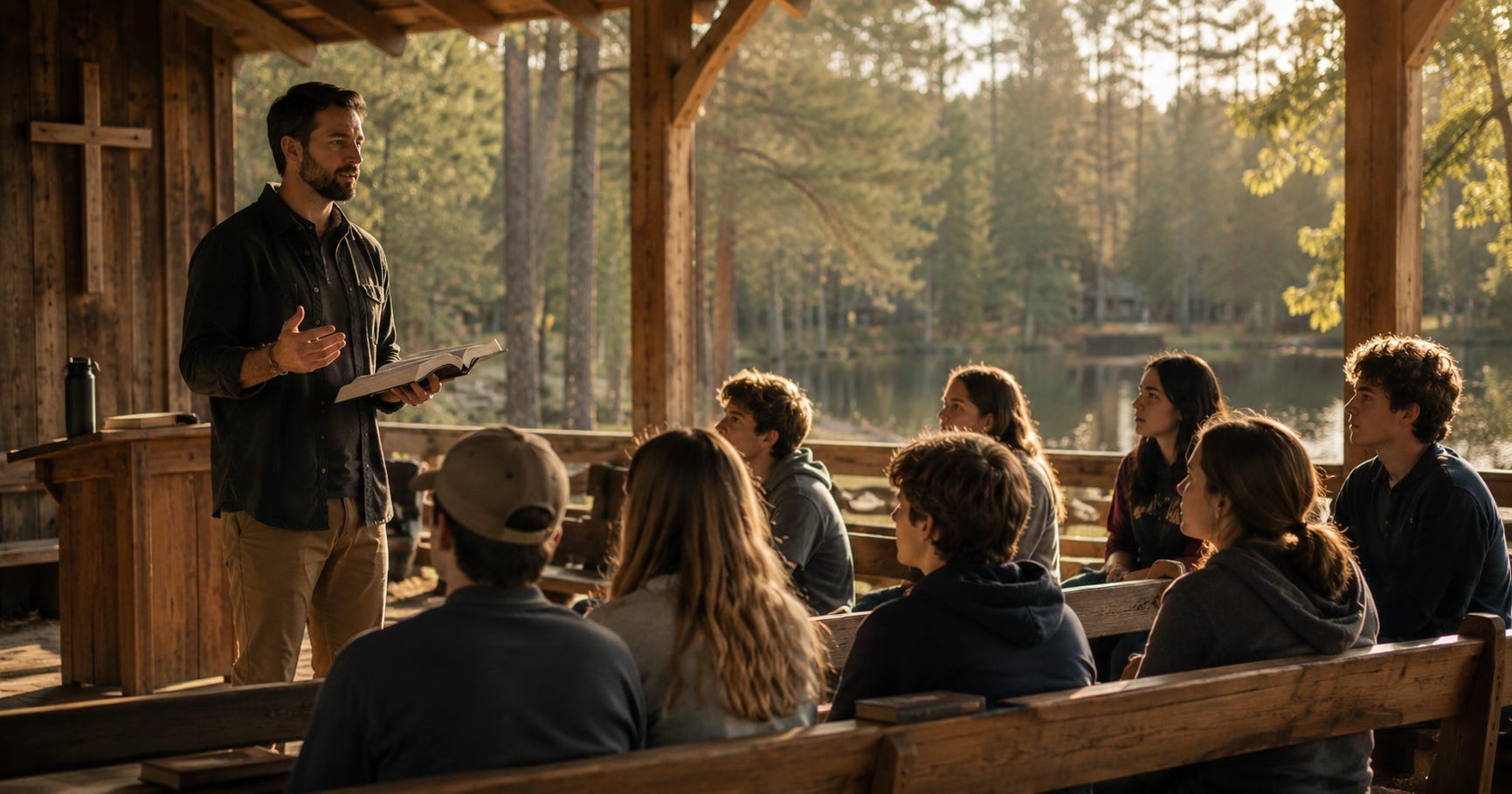
That is the strange challenge for me in trying to write a sermon for teenagers. I am not trying to become one of them, impress them, or prove that church can compete with the world on the world’s terms. I am hoping to just stand before them as a man under authority, holding out the Word of life, and call them to become more than the age expects of them.
And maybe that is what many of them need most; someone who loves them enough to speak plainly, take them seriously, and call them upward into the life of Christ.