

The Stewardship We Pretend Doesn’t Matter
On the Body, Discipline, and the Long Work of Building

| Bookstore | Facebook | Instagram | Threads | Forge & Shield | Dust & Glory Media |
I’ve noticed a strange dichotomy in modern Christianity. On one hand, we reject the modern world’s obsession with the body. And, this is right and good, because almost everywhere you look, the culture catechizes people into vanity, self-worship, aesthetics, “optimization,” and image management. People’s bodies have become projects of self-glorification, and often fitness becomes identity. Which, if you think about it, is just another avenue for narcissism.
Christians should reject that vision entirely. The body is a terrible god.
But, in rejecting body worship, many believers have drifted toward another error altogether: acting as though the body barely matters at all.
As though physical stewardship is superficial, and that perpetual exhaustion is simply the unavoidable cost of modern faithfulness. Because of this, we treat gluttony, passivity, and physical neglect as respectable. The Bible, of course, never treats man as a disembodied mind floating above physical reality. We are embodied creatures.
We are dust animated by the breath of God.
The body is not ultimate. But, neither is it incidental. That distinction matters far more than many Christians are willing to admit, because stewardship always includes the physical.
Weirdly, we understand this instinctively in nearly every other area of life. Christians speak often (and rightly) about stewarding:
money
time
children
marriages
vocations
spiritual gifts
opportunities
influence
But, many Christians rarely speak seriously about stewarding energy, endurance, physical discipline, sleep, appetite, movement, or health. And yet, all of those things directly affect a man’s ability to labor faithfully over the long term.
Our world is producing men who are chronically exhausted, sedentary, distracted, overstimulated, under-rested, and physically incapable of sustained endurance (I should know!). Then, we wonder why so many households feel fragile, why so many churches struggle to build momentum, and why so many men feel perpetually overwhelmed by responsibilities they were designed to carry.
But, weakness has consequences beyond the individual, doesn’t it?
A perpetually exhausted father shapes his household in ways he may not realize. A passive man shapes his church by lack of effort and consistency. And, undisciplined habits eventually shape communities and nations too.
Civilizations are not built by disembodied ideas alone— they are built by embodied men and women capable of discipline, sacrifice, labor, endurance, and long obedience.
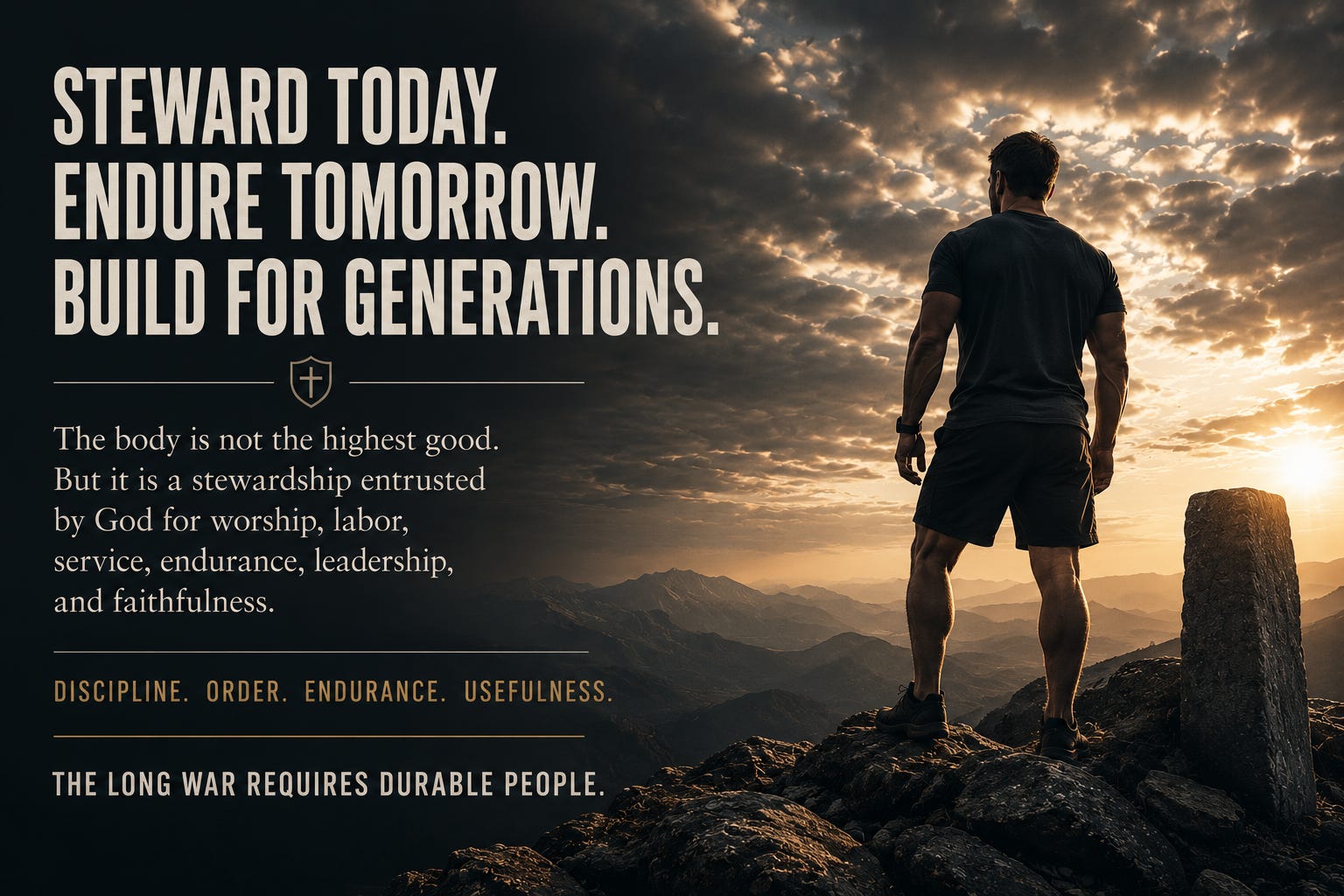
The long war requires durable people.
That statement will likely make some readers uncomfortable, because modern Christians are often suspicious of any conversation involving strength, discipline, or physical stewardship. I understand the suspicion, but too many believers hear these themes and immediately assume vanity, legalism, or macho posturing.
Discipline itself is not vanity, though.
There is nothing worldly about a father wanting enough energy to lead his household faithfully for decades. Nor is there anything sinfully carnal about a pastor recognizing that perpetual exhaustion affects his clarity, discipline, and longevity behind the pulpit.
In fact, one could argue that our current confusion about the body reflects a deeply modern form of practical gnosticism.
Many Christians speak as though “spiritual” things matter while physical things remain secondary.
But, biblical faith has always been profoundly embodied.
God created a physical world and called it good, right? And, Christ took on flesh.
Heck, in the resurrection, we will again have bodies. The point I’m making is that Christianity does not teach escape from embodiment, but the redemption of embodied people living faithfully within God’s world!
That changes how we think about discipline— or, it should anyway.
The modern world tends to divide people into two camps: those who worship the body and those who neglect it. Both are errors. One turns the body into an idol. The other treats the body as irrelevant. We should reject both extremes.
The body is not the highest good. But, it is a meaningful stewardship entrusted by God for worship, labor, service, endurance, leadership, and faithfulness.
That means discipline matters! Sleep matters. Movement matters. Appetite matters. Self-control matters. Strength matters. Endurance matters. Stewardship matters!
And increasingly, I have become convinced that us Christians living in the modern West underestimate how deeply comfort shapes us. I believe that comfort and convenience catechize us without even realizing it. A civilization built around endless ease slowly trains people toward passivity.
Food appears instantly.
Entertainment never stops.
Most work requires little physical movement.
Screens dominate attention spans.
Exhaustion becomes the atmosphere of life.
And, convenience becomes the primary solution offered for that exhaustion.
Then slowly, disorder settles in.
A little less movement and more indulgence. Less discipline and more comfort. No single compromise feels devastating enough to demand confrontation. But eventually, the accumulated weight of those patterns produces people incapable of sustained endurance. And endurance matters more than modern people realize— especially for Christians like me who claim to care about building durable things.
The work of rebuilding households, churches, institutions, and culture is not accomplished through emotional intensity or temporary enthusiasm. It requires decades of faithfulness. It requires men and women capable of laboring steadily without collapsing beneath self-inflicted disorder.
That is why bodily stewardship cannot simply be dismissed as superficial.
Again, the issue is not vanity. The issue is usefulness. I want to live in a Christendom with: useful moms and dads. With useful pastors and workers.
To build this type of society, we must be capable of carrying meaningful responsibility over the long haul.
The Christian life is not merely about surviving spiritually while neglecting every physical stewardship entrusted to us. Nor is it about turning the body into a shrine of self-obsession. It is about rightly ordered stewardship beneath Christ.
The body serves higher purposes:
worship
labor
leadership
service
hospitality
protection
endurance
faithfulness
And perhaps Christians need to recover the courage to say plainly that physical disorder is not always morally neutral.
Not every struggle is laziness, of course, and not every overweight person lacks discipline. But, neither should we pretend that gluttony, passivity, self-indulgence, and neglect suddenly become invisible because they are common (sidebar: Believe me, I’m preaching to myself here. I used to be in pretty excellent shape, but over the past few years, I’ve taken on more and more responsibility, but let my bodily discipline go by the wayside. Now, I’m paying a price for the lack of discipline).
Modern Christians are often comfortable confronting sexual sin, greed, addiction, and pride while remaining strangely hesitant to discuss bodily stewardship at all. Yet, God’s Word speaks repeatedly about self-control, mastery over appetite, discipline, labor, watchfulness, and endurance.
The body matters because stewardship matters. And, stewardship matters because the work before us is long.
Christians, like myself, who intend to build for generations cannot afford to think only in short bursts of motivation. The long war requires rhythms, endurance, discipline, and durable habits capable of sustaining faithfulness over decades. That kind of life will not be built accidentally. It must be cultivated intentionally. One small act of order at a time— and I’m committed to cultivating it myself again!