

The Three Enemies
The Seducer Without (Part II)

Welcome to Part II of the three-part series drawn from Chapter 2 of my new book, available on Amazon, Forged for the Fight: Strength for the War Christ Has Already Won (soon to be available in our bookstore).

I’m genuinely proud of this book. It may be the flagship offering for The Old Forge Press publishing arm. It works well for personal devotion and even better in group study. It is written to clarify the battlefield, not to decorate it.
This chapter, in particular, deserves careful attention here on Substack.
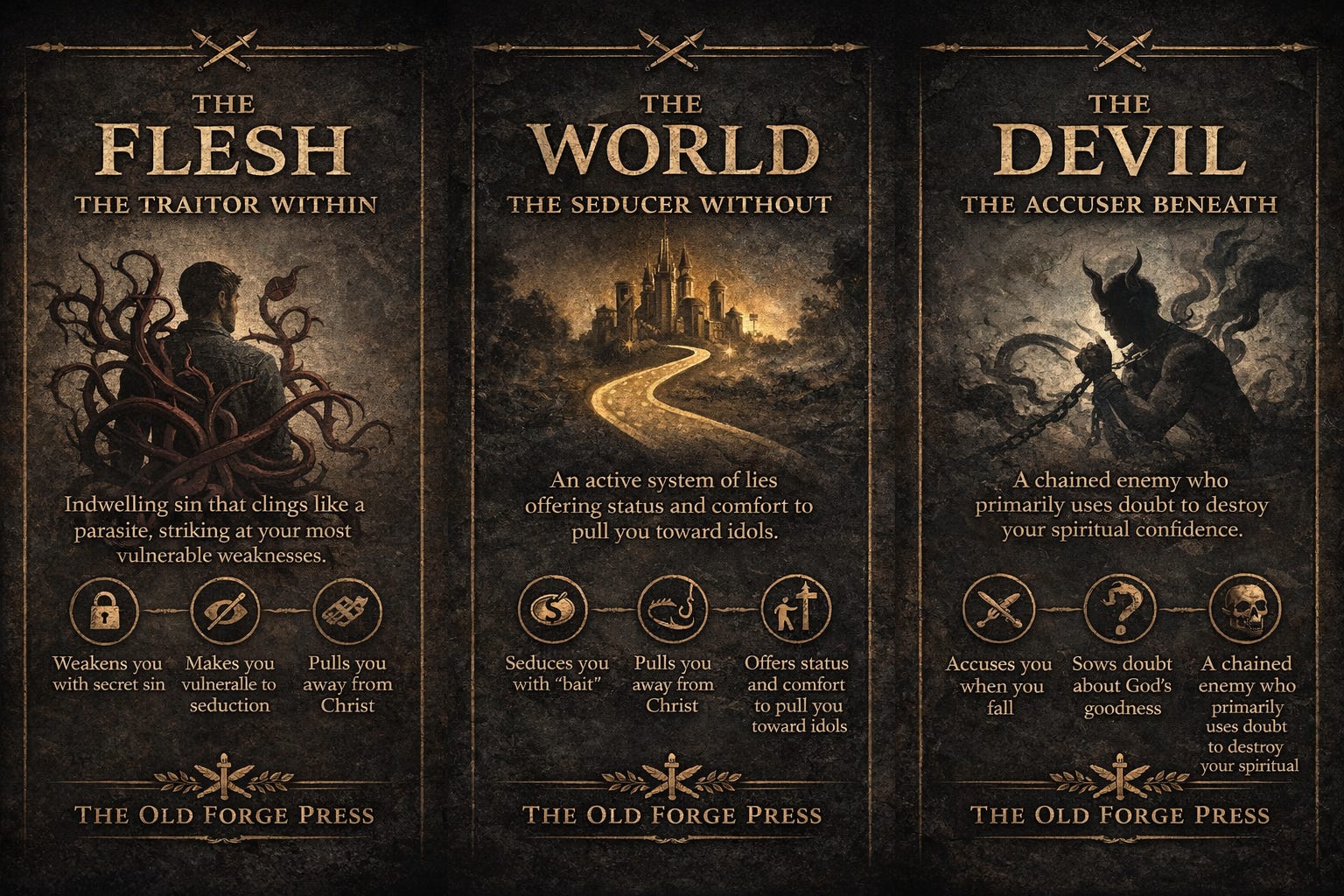
The Christian life is not a vague struggle against negative influences or abstract spiritual forces. Scripture presents it as a war fought on three fronts at once: the flesh within, the world around, and the devil beneath.
These enemies do not operate independently. They reinforce one another. And if we misidentify the primary threat, we will expend enormous effort fighting the wrong battle.
In Part I, we began where Scripture begins, with the traitor inside the walls: the flesh.
Now we turn outward. We must consider the second enemy: the world.
I. The World Is Not Neutral
When Scripture warns us about “the world,” it is not condemning creation. The earth is the Lord’s. Nor is it condemning human culture in every form. Cities can be built for the glory of God. Art, commerce, education, and law can (AND SHOULD) all be ordered toward righteousness.
The world, biblically defined, is something more specific.
“Do not love the world or the things in the world,” John writes. “If anyone loves the world, the love of the Father is not in him” (1 John 2:15). He goes on to define it: “the desires of the flesh and the desires of the eyes and pride of life.”
The world is not dirt and trees and architecture. It is a system of disordered loves. It is an organized pattern of values that exalts what God forbids and minimizes what God commands.
It catechizes.
It evangelizes.
It rewards.
You may have heard from some talking heads that the modern West is post-religious. But, it is not. The modern West is intensely religious!
It has its own creeds, its own saints, its own sacraments, and its own blasphemies. It has a moral hierarchy and a vision of the good life. It has a doctrine of sin and a doctrine of salvation. It simply denies that any of this is religious.
The world does not storm the gates of your home with visible hostility. It seeps in through entertainment, education, advertising, and endless scrolling. It presents its values not as options, but as assumptions. And over time, assumptions become convictions.
The danger of the world is not always persecution. It is persuasion. It does not merely oppose Christ openly. It offers a rival kingdom quietly. And that kingdom promises status, comfort, affirmation, and self-definition…all without repentance, submission, or a cross.
II. The Idols of the West
Every age has its idols. Ours simply pretends it doesn’t. We insist we have moved beyond superstition, beyond shrines and carved images. But, idolatry does not disappear when statues fall. It becomes more abstract, more internal, more unquestioned. An idol is not merely a physical object. It is anything elevated to ultimate importance, anything treated as non-negotiable, unquestionable, and/or morally sacred.
And our culture is full of sacred things.
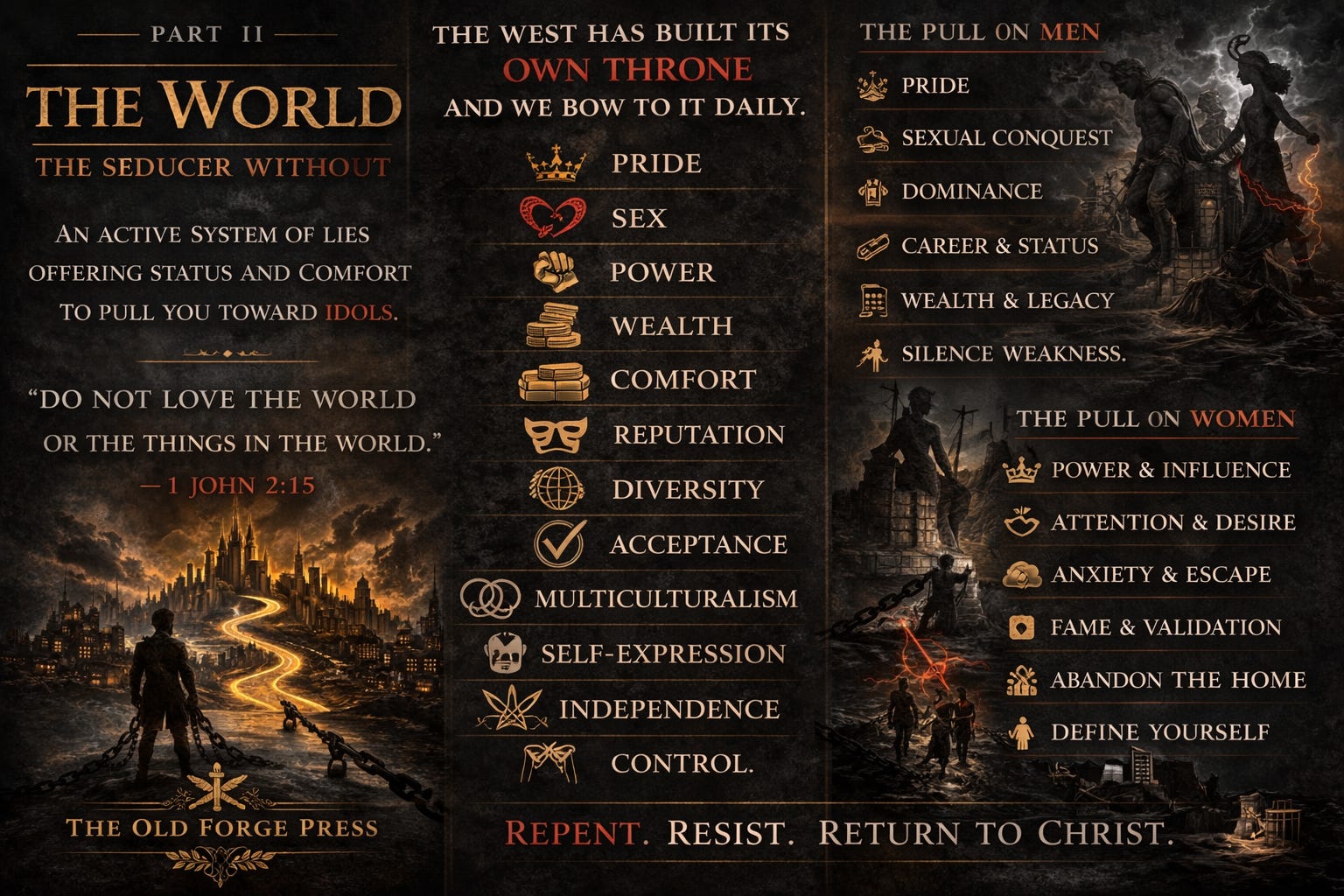
Pride is enthroned as authenticity. We are told that self-definition is the highest virtue. To question someone’s chosen identity is not merely disagreement; it is moral violence. Autonomy has become a moral absolute. Truth be damned!
Sex is detached from covenant and enthroned as self-expression. Desire is treated as revelation. To deny yourself is repression. To discipline your body is harm. The culture catechizes us to believe that fulfillment comes through sexual freedom, not holiness. This is why we have pornography everywhere, and why hundreds of random women have become millionaires on OnlyFans.
“Using all modalities of pornography, 91.5% of men and 60.2% of women herein reported having consumed pornography in the past month.”
Power is baptized as empowerment. Influence is equated with worth. Whether through politics, platform, career, or social media following, authority over others is subtly framed as the measure of a meaningful life.
Wealth and comfort are assumed to be the natural goals of maturity. A life of ease is treated as wisdom. A life of sacrifice is treated as waste.
Reputation has become righteousness. Acceptance functions as salvation. To be affirmed by the crowd is to be justified. To be criticized is to be condemned.
And then there are the newer sacred words: diversity, acceptance, multiculturalism. These are not inherently evil categories in themselves. Scripture itself celebrates the gathering of the nations in Christ. But in our moment, these terms have been absolutized. They function as unquestioned moral goods detached from truth. Diversity is good, even if it requires denying reality. Acceptance is virtuous, even if it requires affirming what God forbids. And, inclusion becomes the highest law, and holiness becomes the greatest threat.
Self-expression replaces obedience. Independence replaces covenant. Control replaces trust.
None of these things are sinful in their proper place. Wealth can serve the kingdom. Cultural diversity can display God’s creative glory. Influence can be stewarded faithfully. But when any created good is elevated above submission to Christ, it becomes an idol.
The world does not tempt us primarily with ugliness. It tempts us with exaggerated goods. And exaggerated goods make the most convincing gods, I’m afraid.
III. The Pull on Men
Let’s make this all practical now.
The world no longer knows what a man is. Neither does it know what a woman is (we’ll cover that next section). After all, like Ketanji Brown Jackson, we’re not all biologists.
When a culture loses its doctrine of manhood, it oscillates between two errors: caricature and erasure.
On one side, men are told that masculinity is inherently dangerous, that strength is toxic, leadership is oppressive, and conviction is violence. They are catechized into passivity. They are told to soften, to apologize, to suppress clarity, to treat decisiveness as aggression. Strength must be rebranded as “emotional availability,” and courage must be filtered through perpetual self-doubt.
On the other side, the culture still dangles older idols: sexual conquest, influence, wealth, dominance. It offers a counterfeit masculinity built on appetite and status. It tells men they are measured by sexual access, physical power, or financial success.
So which is it?
Be soft and harmless, or be powerful and predatory.
The world offers both. And, neither resembles Christ.
Biblical masculinity is not effeminacy, and it is not brutality. It is strength under authority. It is leadership shaped by sacrifice. It is conviction tempered by humility. But the world has no category for strength that kneels.
And so men are confused. Many retreat into passivity. They avoid responsibility under the guise of gentleness. They outsource spiritual leadership in the home. They hesitate to correct error because they fear appearing unkind. They confuse emotional expression with maturity while neglecting discipline, courage, and resolve.
Others double down on appetite. They use sex to feel powerful. They use career to feel significant. They use dominance to silence insecurity. They may speak of “high value” and “alpha” strength, but underneath is the same ancient hunger: to be seen, to be feared, to be admired.
The world pulls men in both directions at once: toward weakness without virtue or strength without holiness. In both cases, Christ is sidelined.
The world does not mind if a man is passive, as long as he is not godly. It does not mind if he is powerful, as long as he is not obedient.
It only fears men who are both strong and submitted.
IV. The Pull on Women
If the world confuses manhood, it destabilizes womanhood even more aggressively.
As with men, the culture offers women two distortions, and encourages both simultaneously. On one side, it preaches hyper-independence. Womanhood is redefined as autonomy, career ascension, and influence without submission. Power becomes the measure of worth. The highest good is self-definition. To prioritize home is framed as waste. To desire motherhood is treated as naïveté. To embrace biblical submission is labeled regression.
The modern catechism whispers: You are most alive when you are visible. You are most valuable when you are powerful. You are most fulfilled when you are desired.
On the other side, the world still weaponizes sexuality. It trains women to measure themselves by desirability. Beauty becomes currency. Attention becomes validation. Social media becomes a liturgy of comparison, anxiety, and curated identity. And, as we saw in the stats earlier, the body becomes a marketing platform.
So women are told: Be powerful like a man, and be desired like an object.
So, strength becomes redefined as dominance, and femininity is reduced to performance. This confusion breeds anxiety. If worth is tied to visibility, you must maintain it. If influence is your identity, you must protect it. If desirability is your leverage, you must sustain it. The result is exhaustion disguised as empowerment.
The pull away from home is not always loud rebellion. It is often subtle devaluation. The ordinary faithfulness of building a household, discipling children, loving a husband, cultivating hospitality; these are reframed as small ambitions. Platform is grand. Visibility is meaningful. Domestic fidelity is optional.
Yet Scripture presents a different vision. It does not demean women; it dignifies them. It does not confine; it roots. The home is not a prison. It is a frontline. But the world cannot celebrate what it does not monetize.
And so many women feel torn. They are told that dependence is weakness, yet they are encouraged to depend on public approval. They are told that submission is oppression, yet they submit daily to cultural expectations about beauty and relevance. They are told that motherhood is limiting, yet they are enslaved to endless self-curation.
The world does not mind if women are powerful. It only resists women who are holy. It does not fear female strength. It fears female obedience.
Just as with men, the goal is not caricature but confusion. If design can be destabilized, identity becomes negotiable. And once identity is negotiable, obedience is optional.
The world offers women power without covenant, desire without purity, and influence without rootedness. And many have believed it.
V. How the World and the Flesh Conspire
The world does not create desire. It exploits it. Richard Alleine captured this centuries ago:
“The world is the bait; the flesh is the appetite; the devil is the angler.”
The world offers pride, sex, power, autonomy, approval. The flesh already wants them. The world simply legitimizes what the heart craves. It tells you that your disordered desires are not sinful, they are authentic. Natural. Dare we say, rights?!?
The flesh says, I want to be admired.
The world says, Build a platform.
The flesh says, I want to feel powerful.
The world says, Redefine the rules.
The flesh says, I want to be desired.
The world says, Display yourself.
The flesh says, I am anxious and insecure.
The world says, Curate yourself until you are affirmed.
The coordination is seamless.
As you can see, and probably already feel, the world does not merely oppose biblical morality; it recasts rebellion as virtue. Pride becomes “self-confidence.” Sexual indulgence becomes “empowerment.” Autonomy becomes “freedom”. Emotional instability becomes “authenticity.” Anxiety becomes “depth.” Rejection becomes “persecution.” And, holiness becomes “repression.”
Because the flesh already leans in these directions, the world’s narrative feels plausible. This is why cultural analysis alone is insufficient. You can critique society all day and still be discipled by it in private. You can mock the excesses of progressivism while quietly worshiping comfort, influence, and approval. You can condemn feminism while nurturing domination in your own home. And, you can reject cultural softness while indulging pornography and ego.
The world does not mind if you rage against it publicly as long as you consume it privately.
The true danger is not merely that the culture is corrupt. It is that its corruption resonates with something inside us. That resonance is the flesh.
If we only attack the world, we will grow self-righteous. If we only attack the flesh, we may grow naive about formation. Scripture forces us to see both. The system outside and the appetite inside are not competing explanations. They are collaborators.
The world supplies the script.
The flesh rehearses it.
And unless we interrupt both, we will play our part in a story that does not belong to Christ.
VI. Counter-Formation
If the world catechizes, then Christians must counter-catechize.
Romans 12:2 does not merely tell us to avoid sin. It commands a deeper resistance: “Do not be conformed to this world, but be transformed by the renewal of your mind.” Conformity is passive. Transformation is intentional. One happens by drift. The other happens by design.
You will be formed. The only question is by whom.
The world forms through repetition. Through screens. Through slogans. Through applause and outrage cycles. Through education that detaches knowledge from obedience. Through entertainment that normalizes what God forbids and mocks what God honors.
If you are not deliberately resisting that formation, you are absorbing it.
Counter-formation begins with reordering loves.
Scripture must speak louder than social media. Worship must shape imagination more than streaming services. Covenant must matter more than career. And, faithfulness must be prized above visibility.
For men, this means rejecting both passivity and predatory strength. It means embracing authority under Christ, leading in repentance as readily as in decision-making, and valuing holiness more than reputation.
For women, this means refusing both domination and performance. It means finding identity not in platform or desirability, but in covenant faithfulness, rootedness, and obedience to Christ.
For households, this means building a rival culture. It means family worship that is not sporadic but normal. It means conversations that are not merely reactive to headlines but shaped by Scripture. It means treating the home not as a staging area for real life, but as the primary theater of discipleship.
The world’s power lies in assumption. It assumes its values are obvious. It assumes its moral hierarchy is inevitable. It assumes its vision of the good life is self-evident. The Christian must reject that assumption.
We are not called to withdraw from the world. We are called to refuse its lordship. Christ has already won the decisive victory. We do not resist in panic. We resist in allegiance.
But resistance is necessary. If the flesh is the traitor within, the world is the seducer without. And seduction is rarely loud. It is patient. It flatters. It assures you that you can keep Christ while quietly absorbing another kingdom’s values.
In Part III, we will turn to the final enemy, the accuser beneath, and examine how Satan weaponizes both the flesh and the world to destabilize confidence in the gospel. The battle is not abstract. And it is not neutral.
If you haven’t read part 1, see below: